Case study
AI Account Management Tools to Scale Marketing Agencies

Every account manager at a growing agency is spending somewhere between four and eight hours a week per client on work that has nothing to do with strategy. Status updates, campaign QA, pulling numbers, writing summaries. These are the hours that cap how many clients the team can carry, and they are the first thing to look at when you want to grow without hiring.
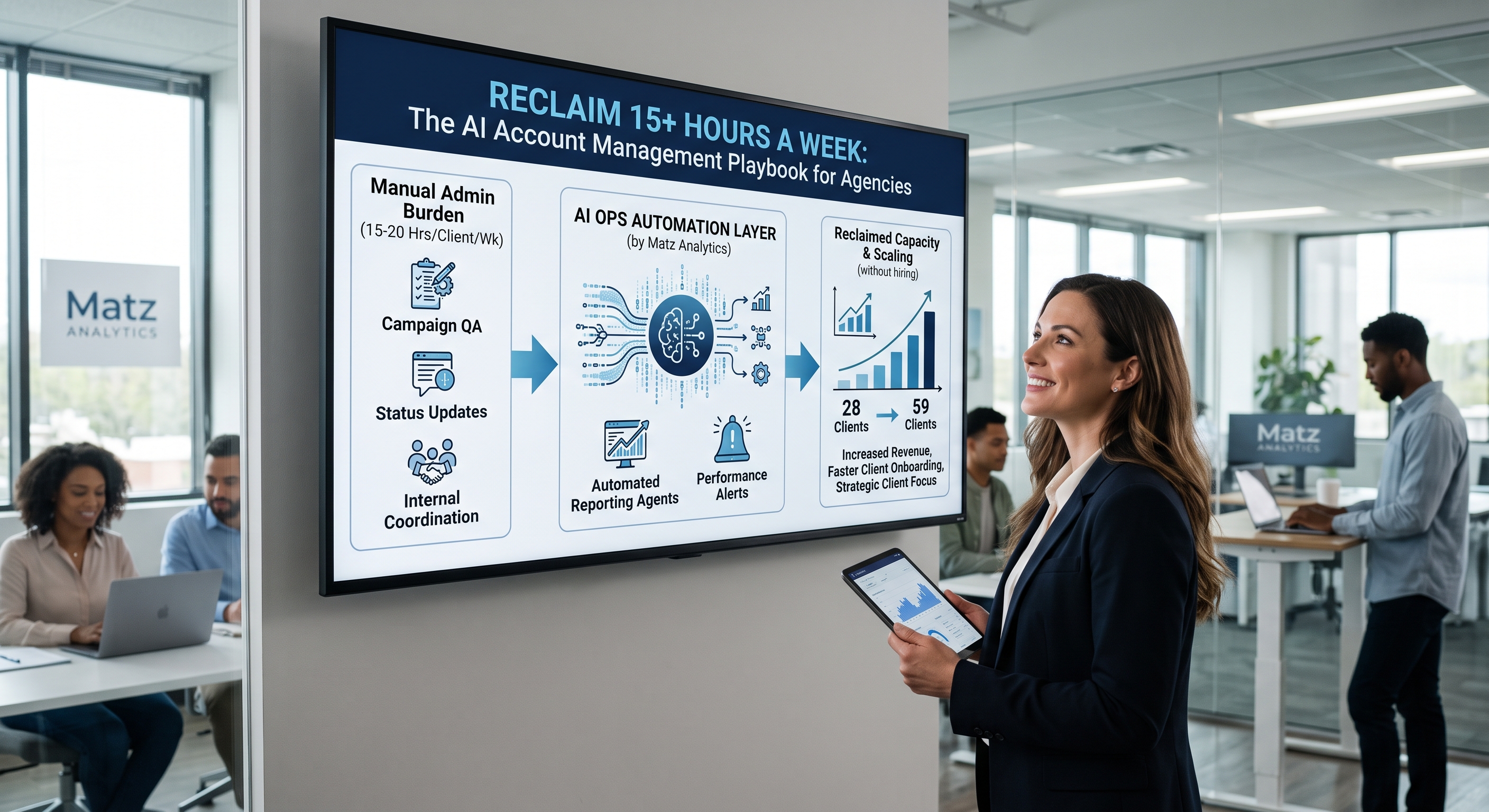
AI account management tools have become the practical answer to this problem in 2026. Not the idea of AI, but actual systems installed inside the agency that handle the repetitive admin automatically. This article is a playbook for agencies that want to know exactly what to automate, how it works, and what it frees up.
What Account Management Actually Costs Your Team Each Week
The manual work breaks into three buckets. First, campaign QA: someone has to check that campaigns are running, budgets are pacing correctly, and nothing broke overnight. At five clients, that is manageable. At twenty, it is a part-time job.
Second, status updates. Every client wants to know what is happening. Someone on the team writes a summary, pulls a few numbers, and sends it. That process repeats weekly or bi-weekly across every account.
Third, internal coordination. The AM has to know what changed, flag it to the right person, and track whether it got resolved. When that happens over Slack threads and spreadsheets, it leaks time constantly.
Add those three buckets together across a ten-client book and you are looking at fifteen to twenty hours a week in pure admin. That is time that does not generate revenue, does not improve campaign performance, and does not help the agency take on more clients. It just keeps the existing clients from feeling ignored.
Why Hiring More AMs Is Not the Fix
The instinct when the team is maxed out is to hire. Another AM, another coordinator, another ops person. That instinct is expensive.
Each new hire compresses margin. They take months to ramp. And they bring their own management load. If the underlying work is still manual, the new person fills up at the same rate the last one did. You have not solved the problem; you have just bought a few more months before it comes back.
The agencies that have broken this cycle have not done it by adding headcount. They have done it by reducing the hours of manual work per client. When each client takes less of the team’s week, the existing team can carry more of them.
That is the math behind AI account management tools. Not replacing people. Removing the manual work so the people you have can handle more.
The Three Automations That Reclaim the Most Time
Automated campaign QA runs checks across every client account on a schedule. Budget pacing, ad status, conversion tracking, anomalies. Instead of a human opening each account and scanning, the system does it and surfaces only the things that need attention. The team reviews exceptions, not everything.
Auto-status updates pull current performance data and generate a structured summary that goes to the client or gets queued for AM review before sending. The AM is no longer writing the update from scratch. They are editing or approving a draft that already has the numbers in it.
Auto-client summaries go deeper. Instead of a weekly email with a few metrics, the system generates a narrative summary of what happened, what changed, and what is being done about it. The AM’s name is on it, but the system built it.
These three automations target the exact hours that compound across a large client roster. Cut two hours per client per week and a ten-client AM gets twenty hours back. That is the capacity to take on five more clients without changing the headcount line.
Which AI Systems Actually Power This
The automations above are not one-off scripts. They run on infrastructure. The relevant systems are two of the six that Matz Analytics builds inside agencies: Custom AI Agentic Solutions and Automated Reporting and Performance Alerts.
The agentic layer is what handles multi-step workflows. A campaign QA agent checks every account, evaluates results against defined thresholds, routes exceptions to the right person, and logs what it found. An account-summary agent pulls data from the ad platforms, formats it against the client’s reporting template, and queues it for delivery. These are not simple automations. They are multi-step processes that cross systems, handle conditional logic, and run without someone triggering them manually.
The reporting and alerts system is what keeps the team ahead of problems instead of behind them. When a campaign drops below a performance threshold, the system catches it and flags it before the client notices. The AM is fixing the issue, not explaining why it happened on the next status call.
Both systems run on a centralized data layer that Matz Analytics builds as part of the installation. Clean, current data from every source the agency uses. Without that layer, the agents have nothing reliable to work from.
What Agencies That Have Done This Look Like
i2i Media was manually attributing and assigning leads from a central pool each week. That work capped how much volume the founder could handle. After Matz Analytics automated the attribution, lead scoring, reporting, and data work, the founder had time to focus on sales and marketing. The agency went from 28 clients to 59 in twelve months with zero new hires.
A lead gen agency running 44 clients had its AMs, founder, and Google Ads team manually pulling data and building reports. Matz Analytics automated the lead scoring, reporting, and data work. They took on 36% more clients in two months, going from 44 to over 60, without adding a single person.
The pattern is the same in both cases. Manual work was eating the team’s week. Automating it gave the team time back. The agency used that time to take on more clients.
How to Evaluate AI Account Management Tools for Your Agency
Most tools in this category are dashboards with some AI features bolted on. They surface data better, but they do not eliminate the manual work. The AM still has to look at the dashboard, interpret it, and write the update.
What actually moves the needle is infrastructure that acts. Systems that run QA, generate summaries, route exceptions, and deliver outputs without a human initiating each step. The difference between a reporting tool and an agentic system is whether the work gets done automatically or whether the tool just makes the work slightly easier.
When you are evaluating options, the question to ask is: after this is installed, which specific tasks does my AM no longer have to do? If the answer is vague, the tool is not solving the problem.
AI Account Management Tools Built for Agencies That Want to Scale
Matz Analytics is a done-for-you AI Ops Department that installs and runs these systems inside agencies. The agentic solutions, reporting infrastructure, and data pipelines are built on the agency’s actual accounts, CRM, and data, not a generic template. The team has done this inside real agencies with real messy data, so the ramp is faster and the systems actually work in production.
If your team is carrying four to eight hours of manual admin per client each week and you want to know exactly what automating that looks like for your roster, book a free demo with Matz Analytics.