Article
7 Ways to Implement AI Call Scoring for Agencies (2026)

Most agencies have a folder of call recordings nobody has listened to. The intake calls, the discovery calls, the “quick check-in” that turned into a churn signal, all sitting there while the team moves to the next fire. AI call scoring exists because that backlog is not a discipline problem, it is a math problem: a team taking 120 calls a week cannot review 120 calls a week by hand.
Do the arithmetic on your own numbers. Eight minutes per call to skim a transcript, tag the lead quality, note the objection, and check whether follow-up actually happened. At 120 calls, that is 16 hours a week of senior attention, because the only people whose judgment matters on these calls are the ones already booked solid.
So it gets sampled. Someone pulls five calls before the Monday meeting, forms an impression, and that impression becomes the official story of lead quality for the month.
The Manual Call Review That Never Gets Scheduled
Here is what the manual version actually looks like inside a lead gen agency. An account manager opens CallRail, filters to last week, sorts by duration, and starts clicking. Half the calls are wrong numbers and spam, so the first twenty minutes produce nothing.
Then the real ones start. The AM listens, decides whether the lead was qualified, checks the CRM to see if the client’s intake team logged it correctly, and finds three that were never logged at all. Now it is a data cleanup task, not a review task.
By call fifteen the AM stops writing notes and starts skimming. By call twenty the tagging is inconsistent with the tagging from the first ten, because there was never a written definition of “qualified” that two people would apply the same way.
That inconsistency is the expensive part. When the client pushes back on lead quality in the QBR, the agency has anecdotes and the client has a spreadsheet from their sales team. Anecdotes lose that argument every time.
Meanwhile the patterns that would actually change performance stay invisible. Nobody notices that the same pricing objection appears in 40 percent of calls from one campaign, or that intake answers on the third ring after 4pm and those leads never convert, or that a specific keyword group produces long calls that never book.
The same failure repeats across the reporting side. An agency asking how to automate competitive analysis reporting across 15 or more client accounts monthly is describing the identical problem in a different tab: work that has to happen every month, on every account, that no human has hours for, so it happens shallowly or not at all.
Both problems have the same root. The agency is paying senior people to do high-volume pattern recognition by hand, and then hiring more senior people when volume grows. The work is the villain here, not the team clicking through the recordings.
Seven Ways to Implement AI Call Scoring for Agencies
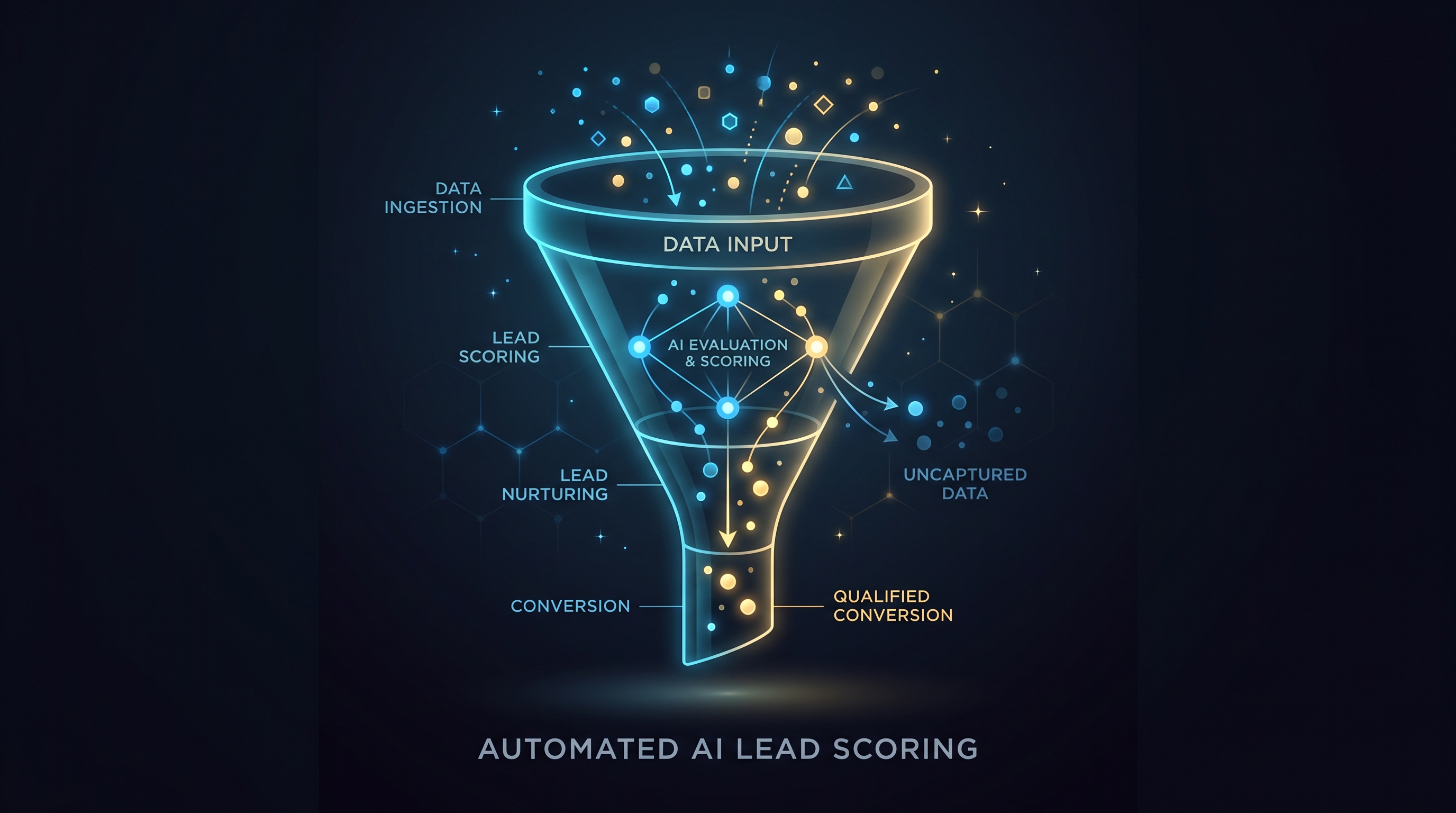
The goal is not a transcript summary tool. The goal is a system that scores every call against criteria your team already argues about, writes those scores into the CRM, and surfaces the patterns without anyone opening a recording.
Start with the scorecard, not the model. Write down the four to six things you actually judge a call on: was the lead in the service area, was there real budget, did the caller have the problem you solve, did intake ask the qualifying questions, did follow-up happen inside the window. Ambiguous criteria produce ambiguous scores no matter how good the model is.
Second, weight the criteria per client. A roofing client’s qualified call and a personal injury client’s qualified call share almost nothing. Custom scoring weights per client are the difference between a score sales trusts and another field nobody looks at.
Third, pick the model for the transcript quality you actually have, not the benchmark. Call transcripts arrive with crosstalk, background noise, and accents, and cheaper models degrade fast on messy audio while costing you accuracy on exactly the calls that matter. Test on 50 of your worst recordings before you commit.
Fourth, score every call rather than a sample. Full coverage is the whole point, since spam and wrong numbers get filtered automatically and the remaining volume is where the signal lives. Sampling is what the manual process already does badly.
Fifth, write scores back into the CRM the client already uses. A score that lives in a separate dashboard creates a second system of record and a new manual step. Scores, reasons, and objection tags belong on the lead record, next to source and medium, where sales already works.
Sixth, connect scoring to attribution. A call attribution tracker tells you which campaign produced the call, and call scoring tells you whether that call was worth producing. Together they answer the question clients actually ask, which is not “how many leads” but “how many real ones, from where.”
Seventh, deploy it inside the sales and intake workflow instead of beside it. Scored calls should trigger the things a human would have triggered: flag the unlogged lead, alert on the follow-up gap, roll objection patterns into the weekly account review automatically.
What Automating Call and Intake Analysis Takes Off the Calendar
Matz Analytics builds this as AI systems it runs for agencies, alongside lead scoring, attribution, automated reporting and alerts, data pipeline automation, and custom agentic work. The call and intake analysis system reviews the calls and intake forms the team never had time to open, and surfaces lead-quality issues, objection patterns, and follow-up gaps on its own.
Mechanically it is unglamorous. Transcripts come in from the call tracking platform already in place, the model scores each one against the client’s weighted criteria, scores and reasons write to the CRM, and anything that breaks a threshold fires an alert. Nothing is plug-and-play, because every agency’s CRM, call tracking, and intake flow is wired differently.
The hours come off in three places. The review itself, which was 12 to 16 hours a week of senior time for a team handling that call volume. The reconciliation work of finding calls that never got logged. And the QBR prep, where the argument about lead quality now starts with scored data instead of five recordings someone skimmed on Friday.
That pattern holds across the other systems too. At one lead gen agency, account managers, the founder, and the Google Ads team were spending roughly 80 hours a month pulling data and building reports by hand before Matz Analytics automated the lead scoring, reporting, and data work. Those hours were not saved in the abstract, they went back to the same people who had been doing the clicking.
The Standard for a Working Call Scoring System
Judge it on one question: can anyone on the team answer what happened across every call last week without opening a recording?
If the answer is yes, intake gaps surface the day they happen instead of the month they cost you renewal, and lead quality conversations run on data both sides can read. If the answer is no, someone is still clicking through recordings on Friday afternoon, and that is the exact work AI call scoring takes off the calendar.